NEORV32 Tutorial & Customization
Educational & Open-Source Contribution (Q3 2021)
Merged into Official Repository
Tutorial successfully merged into the official NEORV32 repository, demonstrating custom peripheral integration methodology.
Project Overview
Timeline: Q3 2021
Type: Open-source contribution / Educational
Objective: Build a comprehensive tutorial on how to add custom IP modules to the open-source NEORV32 microcontroller
Status: ✅ Complete and published
Project Goal
Create a tutorial demonstrating custom peripheral integration for the NEORV32 RISC-V processor:
- Show how to design custom IP modules
- Explain integration with NEORV32 architecture
- Document the complete development process
- Contribute to the open-source RISC-V community
- Provide reference for future custom IP development
NEORV32 Overview
What is NEORV32?
- Open-source RISC-V microcontroller
- Highly customizable processor system
- Extensive peripheral set
- Well-documented architecture
- Active community support
Why NEORV32?
- Perfect for learning RISC-V concepts
- Modular design makes adding peripherals straightforward
- Open-source allows complete transparency
- Good starting point for custom SoC development
Custom IP Module: CRC32 Engine
What We Built
Hardware-Accelerated CRC32 Module
A complete Cyclic Redundancy Check (CRC32) module demonstrating custom peripheral integration through the NEORV32's Custom Functions Subsystem (CFS).
Purpose: - Hardware-accelerated CRC32 calculation for error detection - Common requirement in communication protocols and data integrity - Demonstrates custom peripheral design methodology - Shows integration with processor memory-mapped I/O
Technical Features: - CRC32 polynomial - Standard IEEE 802.3 polynomial - Parallel computation - Combinatorial XOR logic (not iterative) - 8-bit input interface - Process data byte-by-byte - 32-bit result output - Full CRC32 checksum - Memory-mapped registers - Direct CPU access - Runtime detection - SYSINFO capability flags
Technical Implementation
NEORV32 Processor Architecture
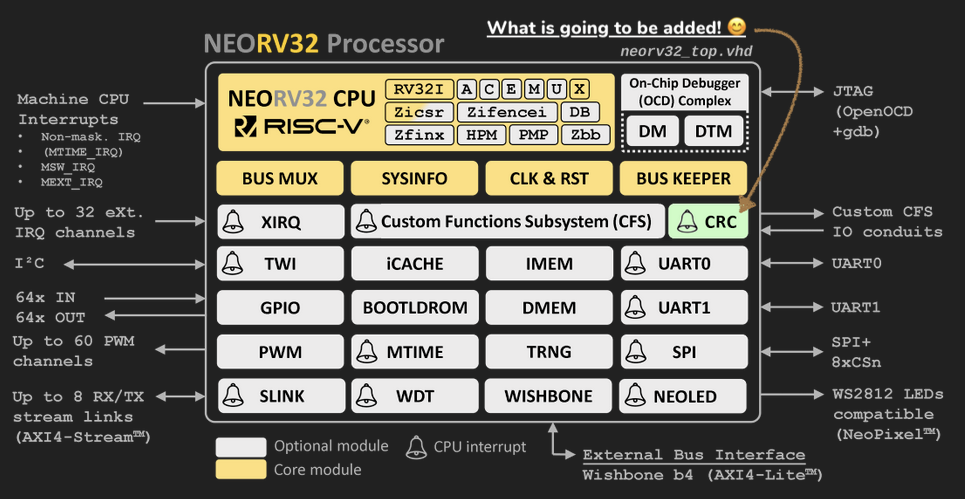
The NEORV32 processor with its NEORV32 CPU core, bus infrastructure, and comprehensive peripheral set. Our CRC32 module integrates through the Custom Functions Subsystem (CFS).
Key Components:
- NEORV32 CPU - 32-bit RISC-V core with configurable extensions
- BUS MUX - Central interconnect with Wishbone bus protocol
- SYSINFO - System information and capability flags
- Custom Functions Subsystem (CFS) - Integration point for custom peripherals
- Memory Systems - IMEM (instruction), DMEM (data), BOOTROM
- Standard Peripherals - UART, SPI, GPIO, PWM, TWI, MTIME, WDT, TRNG, etc.
- Debug Infrastructure - On-chip debugger (OCD) with JTAG interface
CRC32 Module Integration
Integration Point: Custom Functions Subsystem (CFS)
NEORV32 provides the CFS as a template for custom peripherals. Our CRC32 module occupies dedicated address space outside the standard CFS region.
Memory-Mapped Register Architecture:
| Register | Address | Width | Purpose |
|---|---|---|---|
| CRC32_INPUT | 0xFFFFFE78 |
8-bit | Data input (write-only) |
| CRC32_OUTPUT | 0xFFFFFE7C |
32-bit | Computed CRC (read-only) |
Address Space Allocation:
0xFFFFFE00 ────┐
               │ Custom Functions Subsystem (CFS)
0xFFFFFE74 ────┤ 30 registers (reduced from 32)
               │
0xFFFFFE78 ────┤ CRC32_INPUT (8-bit)
0xFFFFFE7C ────┤ CRC32_OUTPUT (32-bit)
               │
0xFFFFFE80 ────┘ PWM and other peripherals
Hardware Computation: - Parallel XOR chains process all 32 bits simultaneously - Combinatorial logic (no clock cycles wasted on iteration) - Results available immediately after final byte written - Implements standard CRC32 (IEEE 802.3) polynomial
FPGA Platform
| Component | Technology |
|---|---|
| FPGA | AMD Xilinx Artix-7 |
| Board | Nexys A7 development board |
| Processor | NEORV32 open-source microcontroller |
| Custom IP | CRC module (designed by Motius) |
Integration Process
Files Modified (5 Core Components)
The integration required careful modifications across the NEORV32 system:
-
neorv32_package.vhd
- Define CRC32 address constants
- Add component declarations
- Create
IO_CRC32_ENgeneric flag - Declare port signals
-
neorv32_sysinfo.vhd
- Add feature bit (bit 29)
- Enable runtime capability detection
- Allow software to query hardware features
-
neorv32_top.vhd
- Instantiate CRC32 module
- Route response bus connections
- Add synthesis reporting
- Connect I/O signals
-
neorv32_test_setup_bootloader.vhd
- Map I/O signals
- Assign LED outputs for visual debugging
- Configure test harness
-
nexys_a7_test_setup.xdc
- Define physical pin assignments
- Map 8-bit LED output display
- Configure FPGA constraints
Integration Workflow
Recommended Approach:
- Prototype in CFS - Test functionality in Custom Functions Subsystem first
- Duplicate Template - Copy CFS structure for new module
- Modify Address Space - Reduce CFS from 32 to 30 registers (free 8 bytes)
- Integrate Response Bus - Connect module to processor bus architecture
- Add SYSINFO Flag - Enable software capability detection
- Validate on Board - Test with FPGA hardware
Software Driver & Usage
C Driver Implementation
The driver provides simple memory-mapped macros for hardware access:
// Memory-mapped register definitions
#define CRC32_BASE    0xFFFFFE78
#define CRC32_INPUT   (*(IO_REG32 (CRC32_BASE + 0)))
#define CRC32_OUTPUT  (*(IO_REG32 (CRC32_BASE + 4)))

// Example usage: compute CRC32 of a string
void compute_crc32(const char *data) {
    // Write data byte-by-byte
    while (*data) {
        CRC32_INPUT = (uint8_t)*data;
        data++;
    }

    // Read final result
    uint32_t result = ~CRC32_OUTPUT;  // Invert for standard CRC32

    printf("CRC32: 0x%08X\n", result);
}
Runtime Capability Detection
// Check if CRC32 module is available at runtime
if (SYSINFO_FEATURES & (1 << SYSINFO_FEATURES_IO_CRC32)) {
    // CRC32 hardware is available
    use_hardware_crc32();
} else {
    // Fall back to software implementation
    use_software_crc32();
}
Tutorial Content
What the Tutorial Covers
1. Architecture Overview - NEORV32 system architecture - Custom Functions Subsystem (CFS) interface - Wishbone bus protocol - Memory mapping strategies
2. CRC32 Module Design - VHDL implementation with parallel XOR logic - Register interface design - Control logic and data flow - CRC calculation algorithm in hardware
3. Integration Steps - Step-by-step modifications to 5 core files - Address space configuration - Response bus routing - Building and synthesizing
4. Software Development - Device driver implementation in C - Memory-mapped register access - Example applications - Performance comparison (HW vs SW)
5. Testing & Validation - Simulation and verification - FPGA testing on Nexys A7 - Debugging techniques with LED output - Performance benchmarking
Key Learning Outcomes
For RISC-V Developers
Custom Peripheral Development: - How to design IP modules for RISC-V systems - Integration with processor bus architectures - Memory-mapped I/O concepts - Hardware/software co-design
For FPGA Engineers
System Integration: - Integrating custom IP with existing systems - Wishbone bus protocol implementation - Timing and resource optimization - FPGA synthesis and place & route
For Students & Researchers
Complete Workflow: - End-to-end custom IP development - Open-source tool usage - Documentation best practices - Community contribution process
Open Source Contribution
Publication
GitHub Repository
Official NEORV32: Merged into main repository
Motius Fork: github.com/motius/neorv32
Branch: add-custom-crc32-module
Status: Successfully merged into official NEORV32 repository
Community Impact
Benefits to RISC-V Community: - Reference for custom IP development - Educational resource for new developers - Demonstrates extensibility of NEORV32 - Lowers barrier to entry for custom peripherals
CRC32 Data Flow
The following diagram shows how data flows through the CRC32 module:
graph LR
    A[CPU] -->|Write 8-bit data| B[CRC32_INPUT<br/>0xFFFFFE78]
    B -->|Byte stream| C[CRC32 Engine<br/>Parallel XOR Logic]
    C -->|32-bit accumulator| C
    C -->|Computed checksum| D[CRC32_OUTPUT<br/>0xFFFFFE7C]
    D -->|Read result| A

    E[SYSINFO] -.->|Capability flag| A

    style C fill:#4CAF50
    style B fill:#2196F3
style D fill:#FF9800Processing Model:
1. CPU writes data bytes sequentially to CRC32_INPUT
2. Each byte triggers combinatorial XOR computation
3. Internal state accumulates across all bytes
4. CPU reads final 32-bit result from CRC32_OUTPUT
5. Result inverted to match standard CRC32 format
Technical Achievements
-
Custom IP Development
- ✅ Designed CRC32 module from scratch in VHDL
- ✅ Parallel XOR logic (combinatorial, not iterative)
- ✅ Memory-mapped register interface
- ✅ Developed device driver in C
- ✅ Hardware-software co-design
-
Integration Success
- ✅ Successfully integrated with NEORV32 core
- ✅ Modified 5 system files systematically
- ✅ Validated on Nexys A7 FPGA
- ✅ Runtime capability detection via SYSINFO
- ✅ Documented complete process
-
Educational Value
- ✅ Created comprehensive tutorial
- ✅ Demonstrated extensibility methodology
- ✅ Provided working example code
- ✅ Merged into official repository
- ✅ Contributed to RISC-V community
-
Performance Benefits
- ✅ Hardware acceleration vs software
- ✅ Zero-cycle parallel computation
- ✅ Immediate results after final byte
- ✅ No CPU overhead during calculation
- ✅ Validated with LED output
Skills Demonstrated
HDL Design
- Verilog/VHDL for custom IP
- Finite state machines
- Bus protocol implementation
- Timing constraints
System Integration
- RISC-V processor architecture
- Wishbone bus protocol
- Memory mapping
- Peripheral interconnect
Software Development
- Device driver development
- Embedded C programming
- Hardware abstraction layers
- Performance optimization
Documentation
- Technical writing
- Tutorial creation
- Code documentation
- Community contribution
Impact on Motius
RISC-V Foundation
This project established our: - Understanding of RISC-V architecture - Custom IP development methodology - Open-source contribution practices - Educational material creation
Building Block
The skills and knowledge gained here directly enabled: - eMil project (Western Digital RISC-V) - Game Engine chip (custom IP to silicon) - Commercial Platform (commercial RISC-V integration)
Open Source Credibility
- Demonstrated technical capability to open-source community
- Established reputation in RISC-V ecosystem
- Created reusable methodologies
- Built foundation for future projects
Lessons Learned
Technical
What worked well: - NEORV32 architecture is well-designed for customization - Wishbone bus is straightforward to implement - Open-source tools are production-ready - Community support is excellent
Challenges: - Timing closure requires careful design - Resource utilization must be optimized - Documentation takes significant effort - Testing and validation is time-intensive
Process
Best Practices: - Start with simple examples - Incremental integration and testing - Comprehensive documentation from start - Community engagement throughout
Next Steps from This Project
This tutorial project led to:
- eMil (2022) - More complex RISC-V integration with WD EH1 core
- Game Engine Chip (2022-2024) - Custom IP → manufactured silicon
- Commercial Platform (2025) - Commercial RISC-V platform development
Progression:
NEORV32 Tutorial → eMil Research → Game Engine Manufacturing → Commercial Platform